Latest Articles
BE RiCEPONSiBLE

BE RiCEPONSiBLE

DOST-PCAARRD Monitors Progress on Benguet Native Pig Project
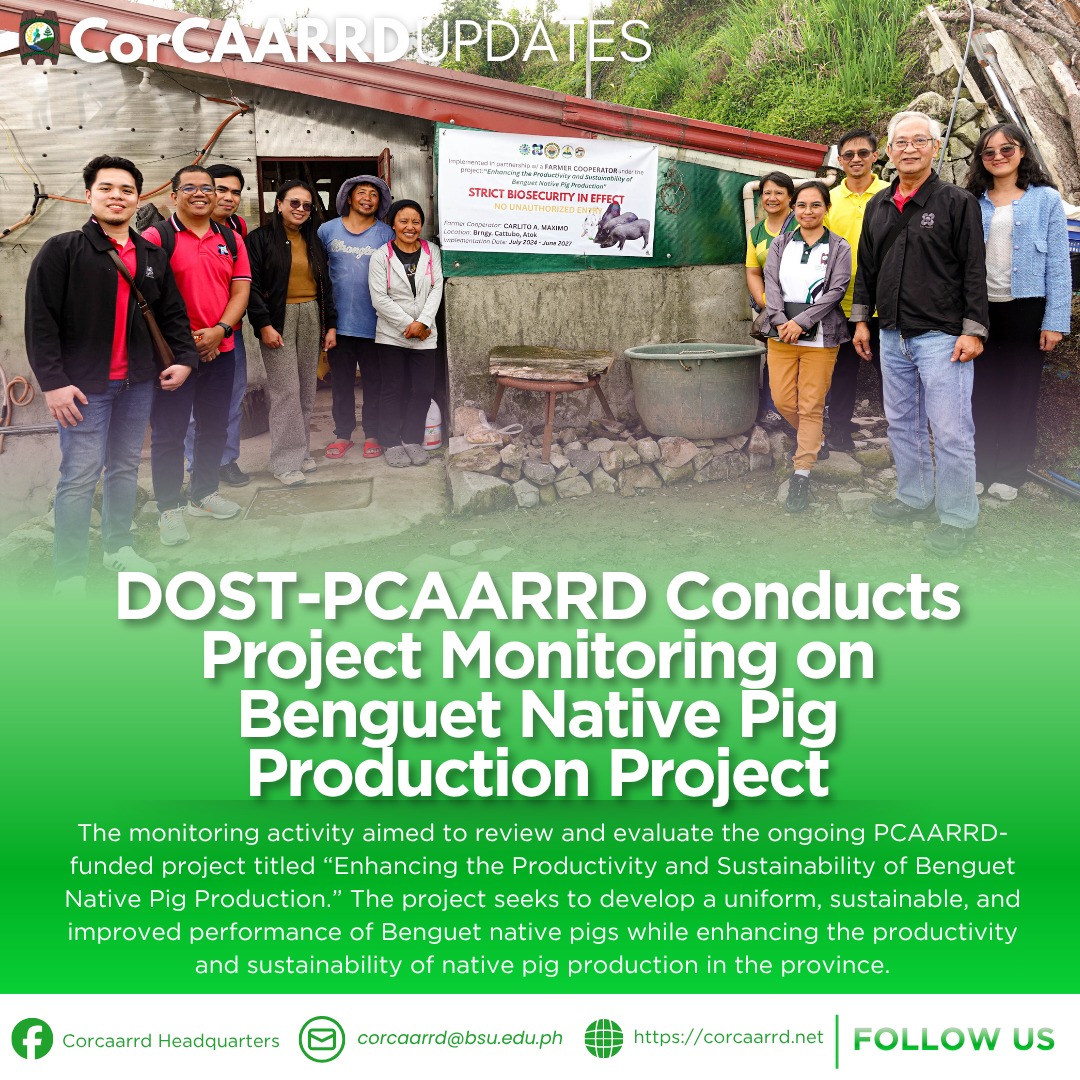
The Livestock Research Division (LRD) of DOST-PCAARRD conducted a project monitoring activity on May 7, 2026. Held at Strawberry Hall in the College of Home Economics and Technology (CHET) of Benguet State University, the event featured a presentation on the project's progress and accomplishments. This monitoring reviewed the ongoing PCAARRD-funded project "Enhancing the Productivity and Sustainability of Benguet Native Pig Production." The project works to develop uniform, sustainable native pigs with improved performance, while boosting overall productivity and sustainability in the province. Dr. Mary Arnel Garcia and her project team led the presentation, joined by Dr. Kenneth A. Laruan and members of the CorCAARRD Secretariat. During the presentation, Dr. Garcia and her team covered the project's background, objectives, and major accomplishments. These included collecting blood samples from Benguet native pig stocks, implementing breeding protocols at the experimental farm, and selecting boars (male pig) for semen collection.The team also studied partially dried Black Soldier Fly larvae and fermented vegetable by products as alternative feeds for native pigs. Five farmer-cooperators formalized partnerships through MOAs with their LGUs, while six more were identified as additional partners. The team stressed strict biosecurity measures, herd health programs, and training on breeding, housing, nutrition, and general pig management for farmer-cooperators. A discussion followed, facilitated by Dr. Ana Mendoza, addressing implementation issues. Topics included selection criteria for sows (female pig) and boars, pig behavior, genetic complement in breeding, production concerns, and other technical aspects of native pig management.The team then visited partner farms. First was Mr. Carlito A. Maximo's farm in Barangay Cattubo, Atok, where the farmer and PCAARRD team shared feeding techniques and pig maintenance practices. Next came Ms. Myrna Malucay's farm in Barangay Balili, Mankayan, to observe native pig behavior and condition. The last field visit was conducted at the farm of Ms. Desie Talabis in Barangay Bangao, Buguias. During the visit, the production of piglets was observed, and recommendations on improving piglet production were shared with the farmer-cooperator. The program started formally with participant introductions led by Ms. Jenefer W. Balwang, Project Technical Aide. Dr. Kenneth A. Laruan delivered a welcome message, followed by Dr. Synan S. Baguio, who shared the rationale for the activity. He emphasized continuous assessment and collaboration to ensure project success. The monitoring team is led by Dr. Synan S. Baguio, along with Dr. Ronilo de Castro, Mr. Lawrence Norte, and Mr. Geleo A. Dichoso. Mr. Leo Laruan closed with thanks to the DOST-PCAARRD monitoring team, project staff, and university administration. He appreciated the comments and recommendations, noting they would serve as challenges and opportunities to improve implementation.
𝐑𝐀𝐈𝐒𝐄 𝐂𝐀𝐑 𝐑𝐞𝐯𝐢𝐞𝐰𝐬 𝐏𝐫𝐨𝐠𝐫𝐚𝐦 𝐏𝐫𝐨𝐠𝐫𝐞𝐬𝐬 𝐰𝐢𝐭𝐡 𝐃𝐎𝐒𝐓-𝐏𝐂𝐀𝐀𝐑𝐑𝐃 𝐓𝐓𝐏𝐃
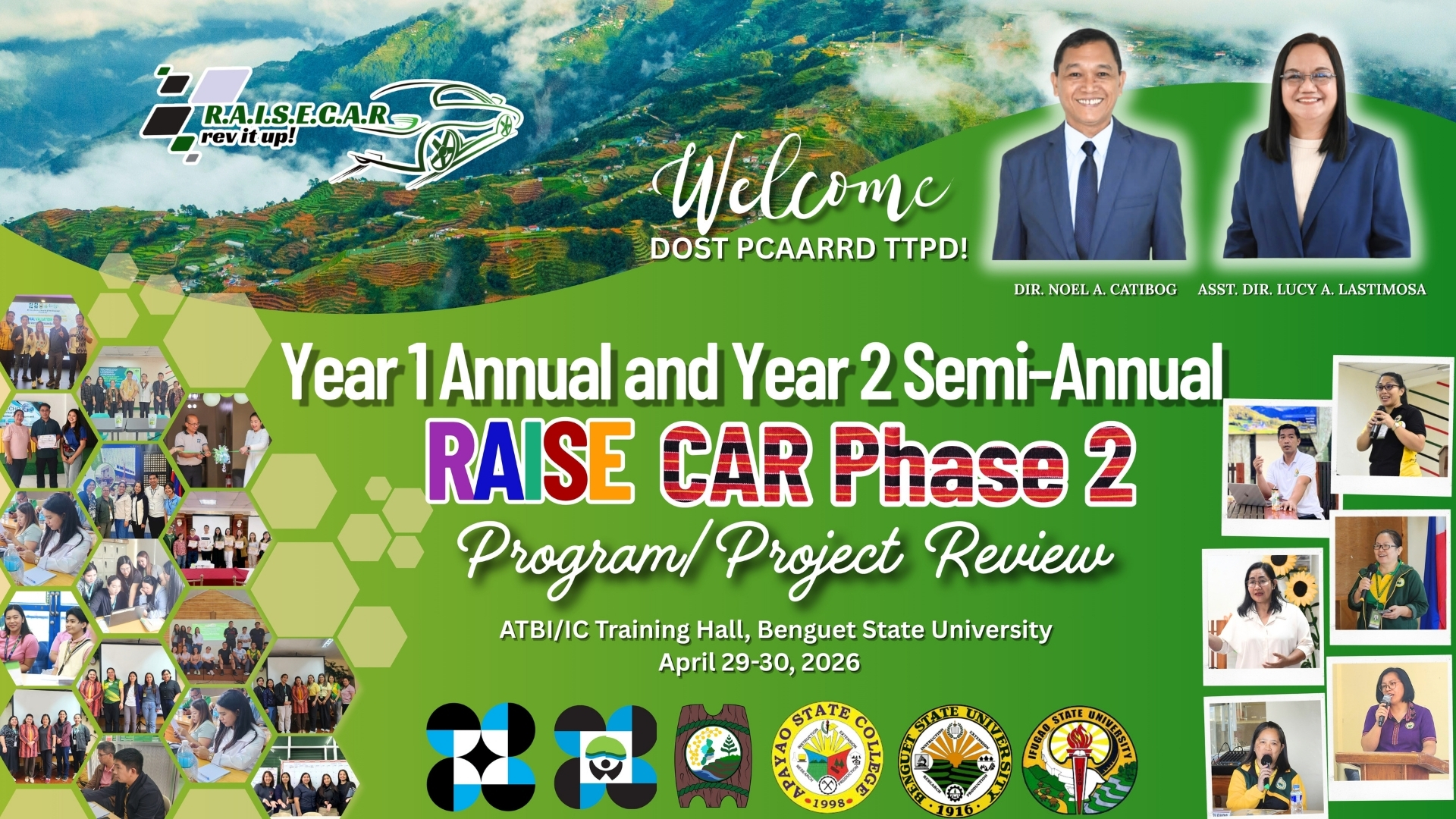
𝐋𝐀 𝐓𝐑𝐈𝐍𝐈𝐃𝐀𝐃, 𝐁𝐄𝐍𝐆𝐔𝐄𝐓 — The Department of Science and Technology - Philippine Council for Agriculture, Aquatic and Natural Resources Research and Development Technology Transfer and Promotion Division (DOST-PCAARRD TTPD) oversaw the Year 1 Annual and Year 2 Semi-Annual Program/Project Review of the Regional Agri-Aqua Innovation System Enhancement (RAISE) Phase 2 implementation in the Cordillera Administrative Region (CAR) on March 29-30, 2026, at the ATBI/IC Training Hall, Benguet State University (BSU).RAISE Project Teams from Apayao State College (ASC), Ifugao State University (IFSU), and BSU welcomed the funding agency delegation led by Director Noel A. Catibog and Assistant Director Lucy A. Lastimosa, assisted by Ms. Lea Joy M. Morong and Ms. Eunice E. Eugenio.“More than the reports, we want to see the story behind the implementation—to know the kwenta and the kwento,” Assistant Director Lastimosa explained, emphasizing the rationale behind the review.The presentation of accomplishments for the seven projects commenced with Dr. Cynthia D. Garambas, Leader of Project 1: Regional Intellectual Property and Technology Business Management (IPTBM). She was followed by two institutional-based IPTBMs: Project 2 (IFSU), led by Dr. Moses B. Appoy, and Project 3 (ASC), led by Dr. Mirasol B. Agpuldo.The IPTBM units reported positive progress regarding Intellectual Property (IP) filings and are currently conducting various capacity-building activities. Notably, the IPTBM in IFSU is already finalizing the commercialization of two technologies.Following the IP reports, Dr. Karen B. Gaerlan, Leader of Project 4: Regional Agribusiness Hub (ABH), presented pre-commercialization initiatives that earned commendation from Assistant Director Lastimosa.Dr. Ruth C. Diego, Leader of Project 5: Regional Agri-Aqua Technology Business Incubator (ATBI), discussed incubation efforts in mentoring potential technology adopters. Concurrently, Dr. Appoy, also leading Project 6: ATBI in IFSU, unveiled accomplishments in the advanced stages, listing several technologies currently in the commercialization pipeline.Finally, Dr. Russell B. Dolendo, Leader of Project 7: Regional Knowledge Management Hub, presented their promotional activities and ongoing initiatives to consolidate and update the program’s knowledge repositories.During the open forum, the TTPD team commended the projects’ best practices, assessed the impact of capacity-building, and provided expert advice on accelerating output completion and strengthening technology commercialization. The first day concluded with a networking dinner hosted by the program lead.On the second day, the RAISE team, headed by Program Leader Dr. Diego, conducted a catch-up planning session to synchronize remaining activities. The team reviewed consolidated scoreboards and identified opportunities for inter-project collaborations.The review concluded with a message from Dr. Roscinto Ian C. Lumbres, BSU Vice President for Research and Extension, who encouraged the implementers to remain steadfast as the region is awaiting the agri-aqua technologies that are useful to the farmers and fisherfolk. 🔗FB link (for more photos):https://www.facebook.com/share/p/1DUyz1Vkns/
Strengthening Regional Research Coordination: CorCAARRD Convenes 2026 1st Quarter RRDCC Meeting at BSU
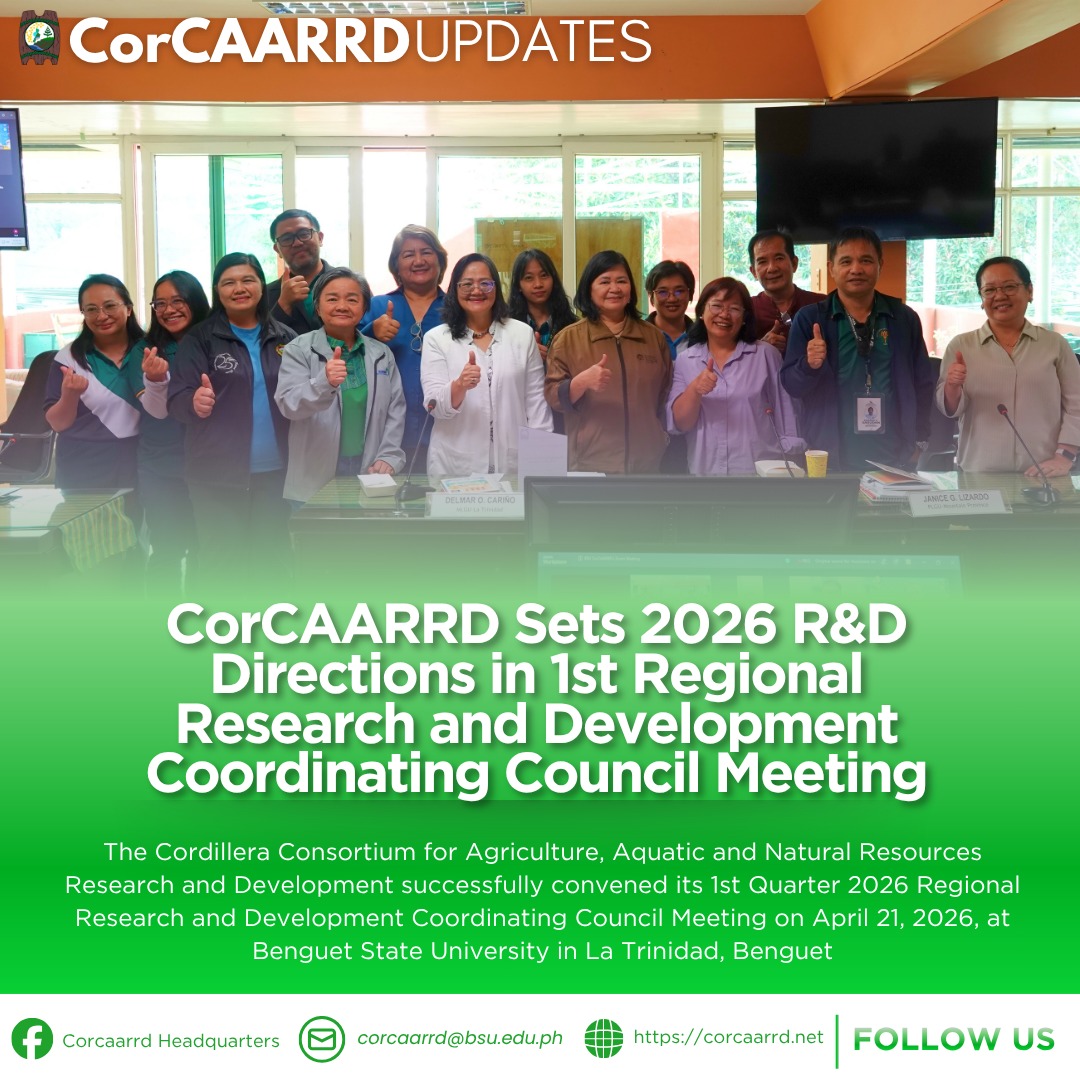
Reinforcing its commitment to advancing research and development across the Cordillera region, the Cordillera Consortium for Agriculture, Aquatic and Natural Resources Research and Development (CorCAARRD) has convened the 2026 1st Quarter Regional Research and Development Coordinating Council (RRDCC) Meeting on April 21, 2026, at Benguet State University (BSU), La Trinidad, Benguet. Held as a hybrid meeting, the activity gathered consortium members both onsite and online. The meeting brought together the Council members to review key developments, discuss priority initiatives, and align directions for the year. Dr. Roscinto Ian C. Lumbres, Vice President for Research and Extension of BSU, delivered the welcome remarks, emphasizing the importance of sustained collaboration among member institutions in strengthening regional research efforts. Following this, Dr. Ruth S. Batani, Consortium Director of CorCAARRD, acknowledged the presence and continued support of consortium members. The meeting was then formally called to order by Dr. Charlie C. Sagudan, CorCAARRD 1st Vice Chair and DA-ATI-CAR Center Director, who facilitated the approval of the agenda and previous minutes. Dr. Batani subsequently presented the actions taken and matters arising. During the business proper, Ms. Fermella Emily Falcon of DOST-PCAARRD presented updates on national initiatives, including GALING PCAARRD Kontra Krisis: Championing Accelerated Crisis Response in the AANR Sector through Effective Science, Technology, and Innovation (STI). The initiative outlined an STI-driven emergency framework aimed at strengthening the resilience of the Philippine agriculture, aquatic, and natural resources (AANR) sector against global market volatility and climate-related disruptions. Additionally, Dr. Darwin A. Basquial, R&D Cluster Coordinator, presented the highlights of the Aduyon Report 2025, detailing key accomplishments and developments in the consortium’s research initiatives. Dr. Batani then presented the final approval of the revised Harmonized RDE Symposium Manual and the Consortium Manual of Operations, reinforcing standardized processes across member institutions. Key agenda items also included the proposed increase in Regional Symposium registration fees and the Training needs assessment result presented by Ms. Jaila S. Sagpa-ey, TechTrans Cluster Coordinator, as well as the presentation and prioritization of commodity roadmaps highlighted by Dr. Basquial. In support of strengthening organizational mechanisms, Dr. Batani presented the survey results on the proposed additional Executive Board positions, followed by discussions by the Council on the updated organizational structure. Meanwhile, Dr. Christine Grace S. Lazaro, SciCom Cluster Coordinator, presented updates on the CMI focal persons and the consortium directory to ensure accurate institutional representation. Moreover, Dr. Nancy A. Bantog, Regional Director of DOST-CAR, announced the upcoming CordINNOVATION event scheduled on April 29–30, highlighting the region’s continuing push for innovation-driven initiatives and strengthened collaboration among stakeholders. Throughout the session, consortium members actively engaged by sharing insights, raising clarifications, and providing recommendations that contributed to informed decision-making and alignment with regional priorities. As the session concluded, Dr. Sagudan adjourned the meeting and expressed appreciation to Benguet State University for hosting and to all participants for their active engagement and valuable contributions.
CorCCARD Holds 1st RTWG Meeting for 2026, Sets Strategic Directions for Regional R&D
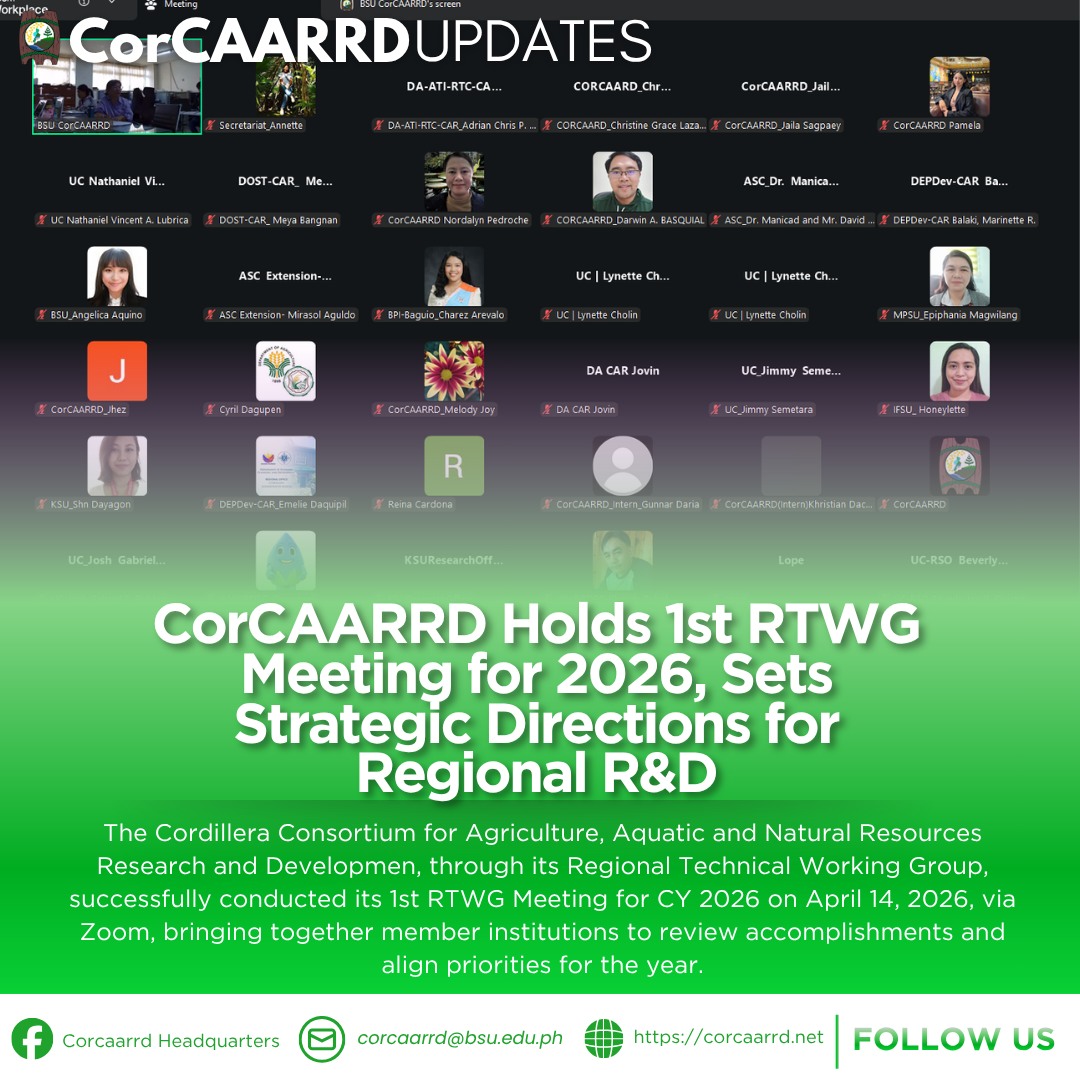
The Cordillera Consortium for Agriculture, Aquatic and Natural Resources Research and Development (CorCCARD), through its Regional Technical Working Group (RTWG), successfully conducted its 1st RTWG Meeting for CY 2026 on April 14, 2026, via Zoom, bringing together member institutions to review accomplishments and align priorities for the year. A key highlight of the meeting was the presentation of the 2025 Aduyon Annual Report by Dr. Nordalyn Pedroche, which showcased major achievements in regional R&D, including successful symposiums, strengthened project monitoring, active technology transfer initiatives, and enhanced partnerships and resource mobilization. To facilitate deeper discussions, participants were divided into four Zoom breakout groups focusing on the Regional Symposium Manual, Manual of Operations, research paper formatting and style, and registration fee. These sessions enabled members to collaboratively review guidelines, propose revisions, and ensure that policies remain relevant and responsive to current needs. Following the breakout sessions, key recommendations were consolidated and presented. Among the major outcomes was the agreement to recommend a Php 800 registration fee per participant per day for the Regional Symposium, in response to increasing projected expenses. Updates to symposium guidelines were also approved, including revised presentation time allocations, removal of reference limits, and the creation of an Ethics and Classification Committee for paper validation. The symposium is also tentatively scheduled on September 28 to October 1, 2026, to be hosted by Kalinga State University (KSU). The RTWG also identified coffee and bamboo as priority commodities for roadmap development and emphasized the need to update RTWG representatives, cluster focal persons, and the expert’s pool, ensuring alignment with agreed qualifications, including academic credentials and ethical standards. Results of the Training Needs Assessment (TNA) further highlighted priority areas in data management, research and extension, and digital skills, which will guide future capacity-building initiatives. The meeting concluded with key reminders on compliance and coordination, including timely submission of reports, adherence to plagiarism and AI policies, and preparation for the upcoming Council Meeting. All proposed revisions, agreements, and recommendations are subject to final review and approval by the Regional Research and Development Coordinating Council (RRDCC) on its scheduled meeting on April 21, 2026, reinforcing the consortium’s commitment to effective collaboration and strengthened regional R&D efforts.
📖 𝗖𝗼𝗿𝗱𝗶𝗹𝗹𝗲𝗿𝗮 𝗖𝗠𝗜𝘀 𝗲𝗹𝗲𝘃𝗮𝘁𝗲 𝗿𝗲𝘀𝗲𝗮𝗿𝗰𝗵 𝘃𝗶𝘀𝗶𝗯𝗶𝗹𝗶𝘁𝘆 𝘁𝗵𝗿𝗼𝘂𝗴𝗵 𝗞𝗻𝗼𝘄𝗹𝗲𝗱𝗴𝗲 𝗠𝗮𝗻𝗮𝗴𝗲𝗺𝗲𝗻𝘁 𝗪𝗼𝗿𝗸𝘀𝗵𝗼𝗽
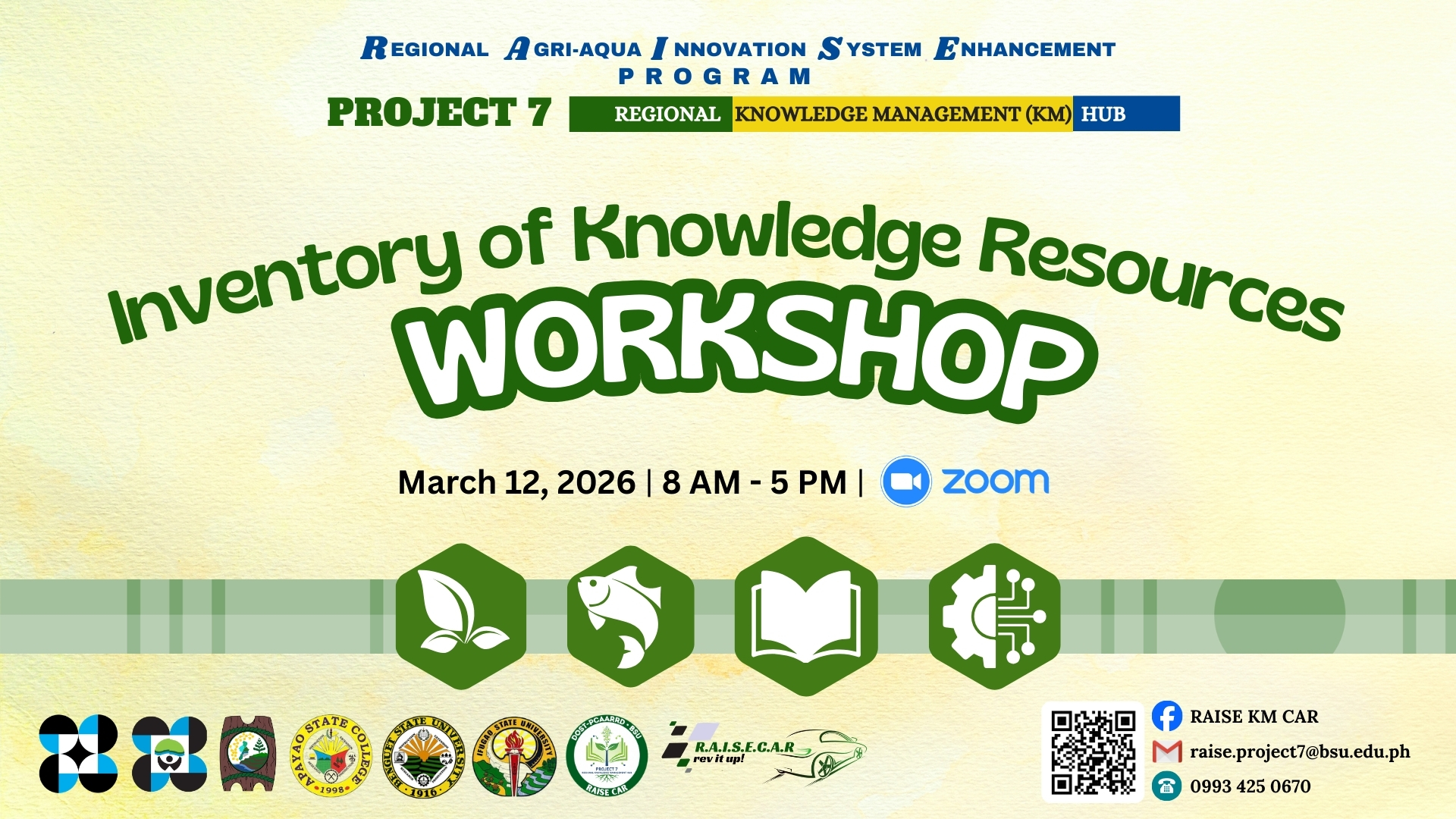
Highlighting the philosophy that “𝘵𝘩𝘦 𝘰𝘯𝘭𝘺 𝘳𝘦𝘴𝘰𝘶𝘳𝘤𝘦 𝘵𝘩𝘢𝘵 𝘨𝘳𝘰𝘸𝘴 𝘸𝘩𝘦𝘯 𝘴𝘩𝘢𝘳𝘦𝘥 𝘪𝘴 𝘬𝘯𝘰𝘸𝘭𝘦𝘥𝘨𝘦,” the Regional Agri-Aqua Innovation System Enhancement (RAISE) Program’s Project 7 – Regional Knowledge Management (KM) Hub convened 64 participants from Cordillera Consortium Member Institutions (CMIs) for the Inventory of Knowledge Resources (IKR) Workshop on March 12, 2026, via Zoom video conferencing. Aimed at maximizing the value of knowledge products, the workshop emphasized the importance of systematically organizing publications and making them accessible to a wider audience through digital repositories. The activity gathered representatives from the region’s State Universities and Colleges (SUCs), including Apayao State College (ASC), Ifugao State University (IFSU), Kalinga State University (KSU), Mountain Province State University (MPSU), and the University of Abra (UA), alongside the host institution, Benguet State University (BSU). The program officially commenced with welcome remarks from Dr. Roscinto Ian C. Lumbres, BSU Vice President for Research and Extension. He underscored the urgency of establishing a centralized platform for technology generators, emphasizing that a “one-click” hub is essential to ensure the region’s research is visible and utilized for technology transfer. “We have to make sure we know what we are managing… so that we don’t miss opportunities,” Lumbres noted, urging CMIs to work hand in hand to uphold the excellence of the Cordillera. The technical sessions began with Mrs. Ivy Jane V. Miguel, Chair of the Department of Development Communication at BSU, who provided an introduction to KM and resource inventory. She addressed common misconceptions, emphasizing that KM goes beyond generating information, education, and communication (IEC) materials—which she described as merely the “tip of the iceberg”—and instead focuses on knowledge that is understood and applied. She also highlighted the distinction between explicit and tacit knowledge, noting that valuable expertise may be lost if not properly captured when employees retire or resign. Following this, Mr. Joven D. Dongga-as, BSU College Librarian II, discussed documentation standards and practical exemplars. He shared the BSU Library’s digitization experience and introduced tools for preservation, including metadata management and the use of PDF24 Toolbox for digital conversion to ensure that institutional resources remain searchable. This was followed by the introduction of a regional digital platform. Ms. Jessa W. Ente, Science Research Analyst at CorCAARRD, presented the Information System of CorCAARRD (ISCORD), a central repository designed to unify AANR research and project monitoring across 21 member institutions, thereby enhancing knowledge accessibility for local highland innovations. A comprehensive orientation on the DOST-PCAARRD eLibrary was then delivered by Ms. Marina T. de Ramos, Manager of the platform. She described it as a digital knowledge-sharing system that provides free, 24/7 access to over 10,000 agricultural and natural resource documents, helping bridge the gap between traditional research and modern accessibility for both the R&D community and the general public. Mr. Juan Carlo J. Longamen, Science Research Specialist I at DOST-PCAARRD, subsequently provided a technical guide on digital conversion and processing for integrating local knowledge resources into the national library system. He detailed the six-step digitization and metadata tagging process used to transform physical agricultural research into searchable, high-quality digital assets. He also demonstrated tools such as ScanTailor for image enhancement and deskewing, and Adobe Acrobat for creating searchable, archival-grade PDF/A files with MARC 21 metadata. As a hands-on application of these sessions, participants were tasked to accomplish a Knowledge Resource Profile Form. This serves as a vital attachment to the IEC materials they will submit as workshop output, ensuring that each material is properly indexed and categorized upon submission to the KM Hub. In her closing remarks, Dr. Russell B. Dolendo, Project Leader of RAISE Project 7, emphasized that knowledge resources are “valuable assets” of an organization. She noted that conducting a systematic inventory is a crucial step toward preserving institutional memory and strengthening research across partner institutions. “The outputs we produce today will serve as a strong foundation for developing more organized, accessible, and sustainable knowledge management practices,” Dr. Dolendo concluded. #IKRW2026 #RAISECAR #BenguetStateUniversity #RAISEP7KMHub #DOSTPCAARRD #dostforu
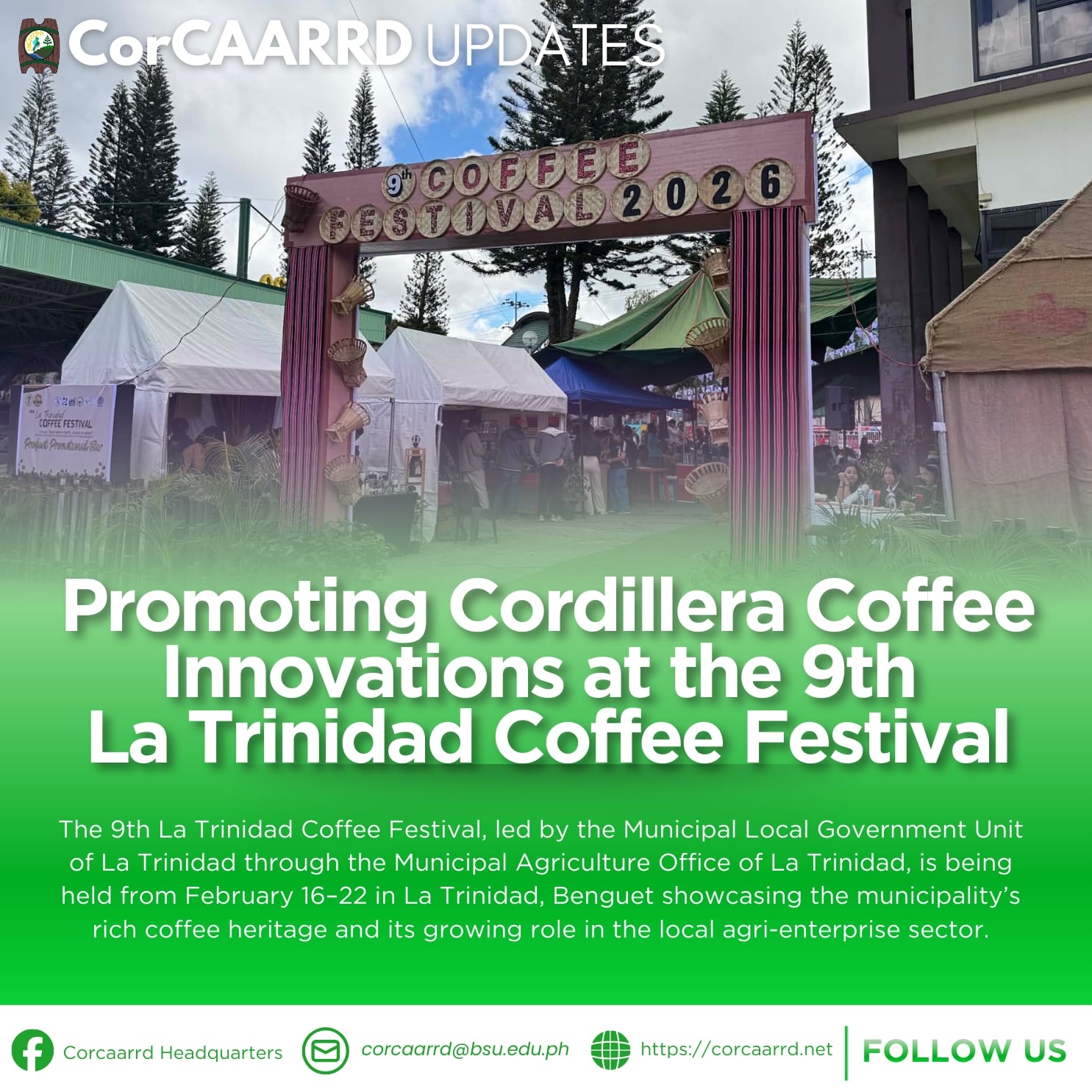
𝐏𝐫𝐨𝐦𝐨𝐭𝐢𝐧𝐠 𝐂𝐨𝐫𝐝𝐢𝐥𝐥𝐞𝐫𝐚 𝐂𝐨𝐟𝐟𝐞𝐞 𝐈𝐧𝐧𝐨𝐯𝐚𝐭𝐢𝐨𝐧𝐬 𝐚𝐭 𝐭𝐡𝐞 𝟗𝐭𝐡 𝐋𝐚 𝐓𝐫𝐢𝐧𝐢𝐝𝐚𝐝 𝐂𝐨𝐟𝐟𝐞𝐞 𝐅𝐞𝐬𝐭𝐢𝐯𝐚𝐥
𝙻𝙾𝙾𝙺! | 𝐂𝐨𝐫𝐂𝐀𝐀𝐑𝐑𝐃 𝐏𝐚𝐫𝐭𝐢𝐜𝐢𝐩𝐚𝐭𝐞𝐬 𝐢𝐧 𝐏𝐂𝐀𝐀𝐑𝐑𝐃’𝐬 𝐆𝐨𝐥𝐝𝐞𝐧 𝐀𝐧𝐧𝐢𝐯𝐞𝐫𝐬𝐚𝐫𝐲 𝐂𝐞𝐥𝐞𝐛𝐫𝐚𝐭𝐢𝐨𝐧

CorCAARRD, led by RRDCC Chairperson and Benguet State University President Dr. Kenneth A. Laruan, joined the 2025 PCAARRD and Regional Consortia Joint Celebration of the Golden Anniversary of the Consortia System at the SMX Convention Center Manila on January 30, 2026. During the event, CorCAARRD was honored for reaching its “𝘎𝘰𝘭𝘥 Milestone,” commemorating 47 years of service in the region since its establishment on November 17, 1978. In addition, Consortium Director Dr. Ruth S. Batani received recognition for her dedicated leadership and outstanding service, having steered the consortium for more than eight years as Director and R&D Cluster Coordinator. BSU, as the base agency of CorCAARRD also reaffirmed its commitment through the launch of a new initiative titled “Sustaining AANR Development through Expanded Collaboration and Partnerships in the Region.” Scheduled for implementation from 2026 to 2027, the project will strengthen programs in research and development management, strategic research, results utilization, capability-building, governance, and policy advocacy. The initiative underscores CorCAARRD’s continuing role in driving regional progress while aligning with PCAARRD’s nationwide vision of advancing the AANR agenda. || 𝙰𝚃𝙱
𝐅𝐑𝐎𝐌 𝐈𝐍𝐍𝐎𝐕𝐀𝐓𝐈𝐎𝐍 𝐓𝐎 𝐈𝐌𝐏𝐀𝐂𝐓 | Training of Trainers on Assessing Technologies
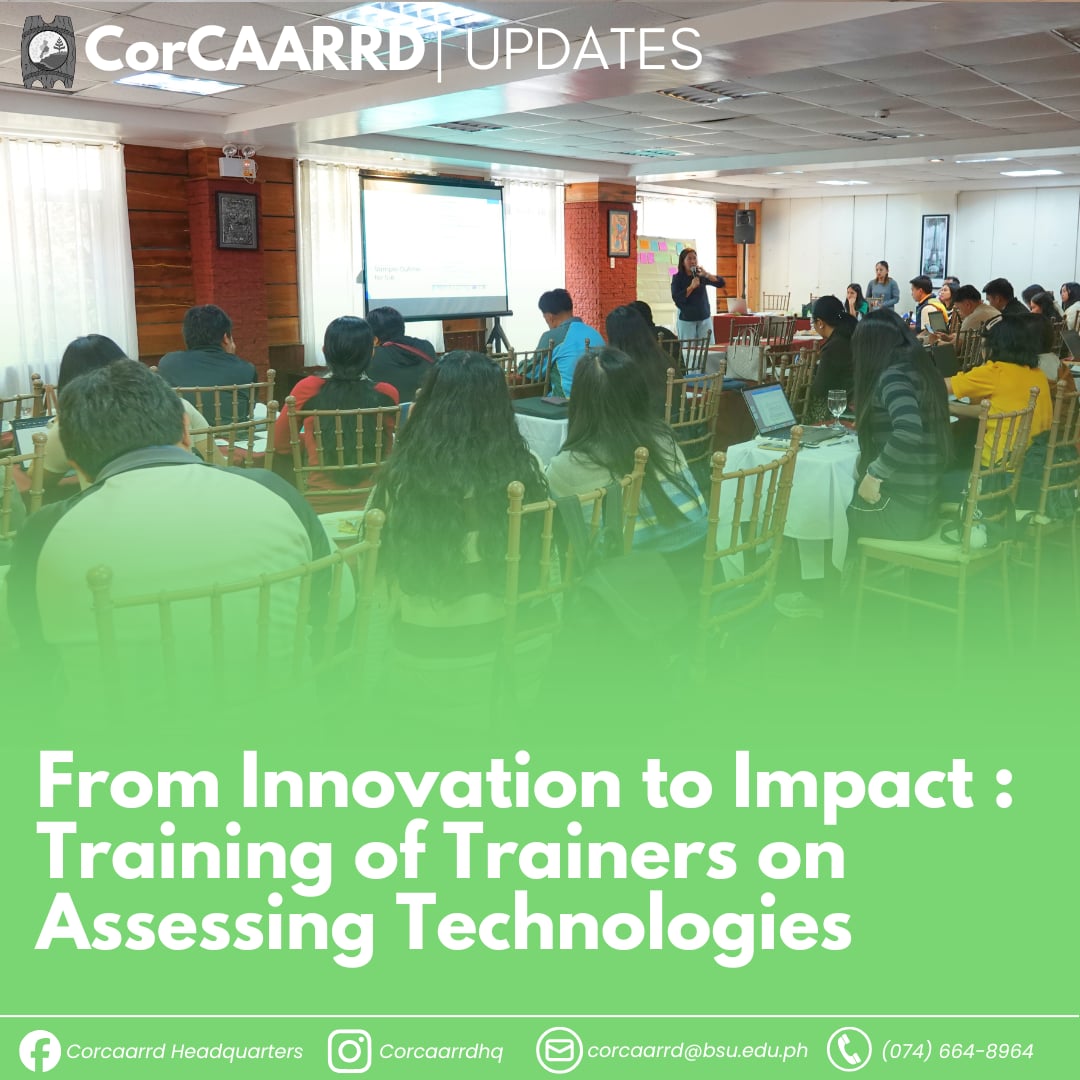
January 14–16, 2026 | Villa Silvina Hotel & Restaurant, Outlook Drive, Baguio City The Cordillera Consortium for Agriculture, Aquatic and Natural Resources Research and Development (CorCAARRD) successfully conducted the 3rd Series of the Non-Degree Training-Workshop titled “From Innovation to Impact: Training of Trainers on Assessing Technologies” on January 14–16, 2026, in Baguio City. The activity aimed to strengthen the capacity of Consortium Member Institutions (CMIs) to plan and implement Technology Impact Assessment (TIA), particularly in assessing social impacts, monitoring technology implementation, and generating evidence to support informed decision-making and future research and development interventions. The training formally opened with welcome remarks from Dr. Ruth S. Batani, Consortium Director, who underscored that impact assessment is essential in ensuring that research investments translate into meaningful and measurable benefits for communities. She emphasized that technologies should not only be developed and disseminated but must also be systematically assessed to determine their real-world relevance, adoption, and contribution to development goals. Dr. Batani also acknowledged the active participation of representatives from various CMIs across the region. Following this, Ms. Jaila S. Sagpa-ey, TechTrans Coordinator, presented the overview of the activity. She outlined the key objectives of the training, which included: (1) enhancing participants’ understanding of Technology Impact Assessment concepts and frameworks; (2) equipping CMIs with practical tools for social impact assessment, monitoring, and stakeholder analysis; and (3) guiding participants in the development of draft Technology Impact Assessment Plans for selected institutional technologies. The training was facilitated by Ms. Joan Guillao of the Indigenous Peoples Rights International (IPRI), who served as the resource person. The first-day sessions focused on Social Impact Assessment, covering its purpose, scope, and role in measuring changes among intended beneficiaries. She highlighted that impact assessment should be conducted not merely as a compliance requirement but as a learning tool to improve technology design, implementation, and sustainability. Ms. Guillao also emphasized that well-timed and properly designed assessments allow institutions to capture both short-term outcomes and long-term impacts of technologies. Key topics discussed included the importance, timing, and types of impact assessment, as well as the selection of indicators used to measure sustainable outcomes. Participants were then engaged in institutional-level exercises using SWOT (Strengths, Weaknesses, Opportunities, and Threats) and PESTLE (Political, Economic, Social, Technological, Legal, and Environmental) analyses to identify internal and external factors affecting technology implementation. The outputs were presented and reviewed to guide improvement and ensure alignment with impact assessment objectives. In the afternoon, sessions focused on Program Monitoring, highlighting its role in tracking implementation progress and supporting timely management decisions. This was followed by a discussion on Stakeholder Analysis and Engagement, which covered stakeholder identification, mapping, and assessment of stakeholder influence and interests. The day concluded with a practical exercise where participants defined assessment boundaries, identified key stakeholders, and developed stakeholder maps for their selected technologies. The second day covered Data Collection and Baseline Assessment, including the purpose of baseline data, its linkage to indicators, and the selection of appropriate indicators for impact measurement. Ethical considerations and commonly used data collection tools were also discussed to ensure data quality and integrity. In the afternoon, participants worked on developing a Technology Impact Assessment Plan for a selected technology from their respective institutions. Each plan included the background, objectives, indicators, data collection methods, and a preliminary budget. Participants used the workshop sessions to refine their drafts in preparation for presentation on the final day. On the third day, selected CMIs presented their Technology Impact Assessment Plans, followed by discussions where technical comments and recommendations were provided to further improve the outputs. Participants shared key insights gained from the training. One participant noted that the workshop helped clarify how impact assessment can be integrated early in the project cycle rather than being conducted only after project completion. Another participant emphasized that learning how to identify appropriate indicators and stakeholders strengthened their confidence in implementing impact assessments within their institution. Overall discussions and submitted outputs demonstrated that participants gained a clearer and more practical understanding of how Technology Impact Assessment can be applied within their respective CMIs to support evidence-based decision-making. The activity concluded with a message from Dr. Charlie Sagudan, RRDCC Vice Chair of CorCAARRD and Center Director of DA–ATI–RTC–CAR. He discussed current challenges and emerging trends in the agriculture sector at both national and global levels and emphasized the importance of ensuring that research and development initiatives lead to tangible and lasting outcomes. Dr. Sagudan highlighted the word “IMPACT” as a guiding principle for R&D work. He explained that “I/Im” represents the individual researcher and implementer and the personal responsibility to create change; “ACT” underscores the need for concrete actions beyond planning and reporting; and “P” stands for sustained partnerships, emphasizing collaboration among CMIs and other government agencies. He encouraged participants to carry these principles into their work to achieve meaningful and lasting impact in the communities they serve.
REGIONAL R&D AGENDA (2023-2028)
Regional Clusters
BANNER OF PROGRAMS
Regional Focus Commodities
Feature Articles
| No feature articles found. |